
In short
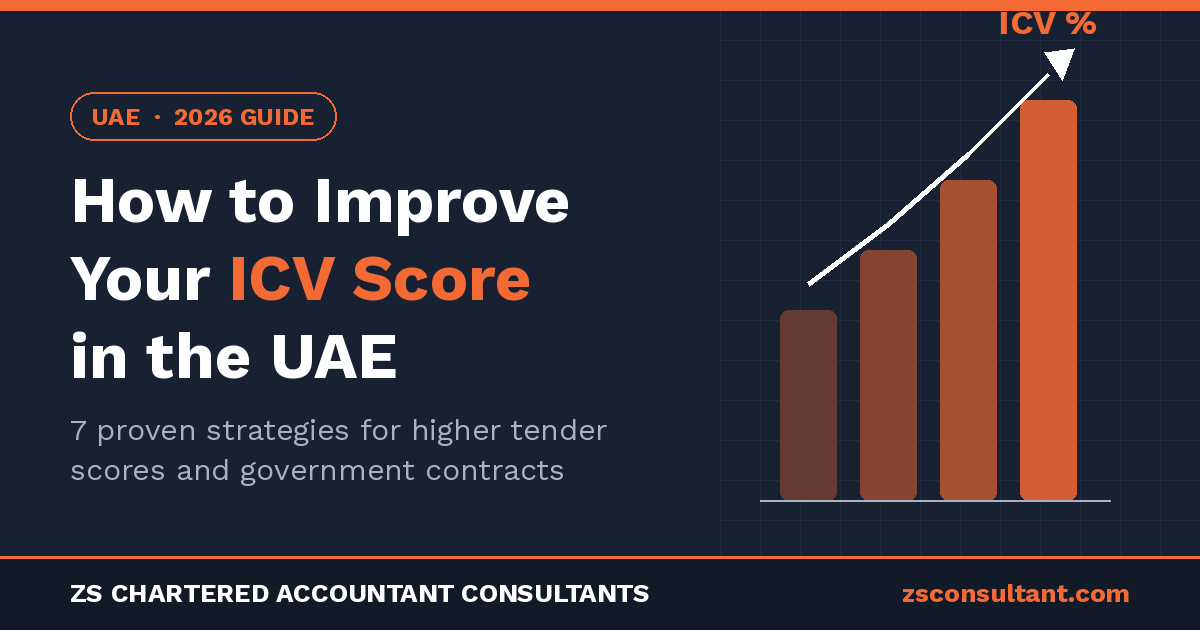
Learn 7 proven ways to improve your ICV score in the UAE for 2026. Local procurement, Emiratisation, investment and audit tips from Abu Dhabi ICV specialists.
If your company bids for contracts with ADNOC, government entities or the major semi-government groups in the UAE, your ICV score is now part of your commercial pricing. Two suppliers can quote the same number, and the one with the stronger In-Country Value score takes the contract. The good news is that the score is not fixed. It is recalculated every certification cycle from your audited financial statements, which means the decisions you make during this financial year directly decide the score on your next certificate.
At ZS Chartered Accountant Consultants, we help companies across Abu Dhabi and the wider UAE assess, certify and raise their ICV scores. Below are the seven strategies that consistently deliver results, in the order most companies should tackle them.
First, Understand What Feeds the Score
The ICV score is generated by the standard formula issued by the Ministry of Industry and Advanced Technology (MoIAT) and applied by authorised certifying bodies. It is calculated entirely from verified financial data. The main inputs are:
- Spending on goods and services from UAE-based suppliers, weighted by each supplier’s own ICV certificate
- The net book value of assets your company holds inside the UAE
- Employment of UAE nationals, including salaries, training and role seniority
- Salaries and benefits of your UAE-based expatriate workforce
- Bonus items such as export revenue and growth in Emirati headcount
Every strategy below works by increasing one of these inputs or by making sure it is fully captured in your audited figures.
Strategy 1: Audit Your Supplier Base Before Anything Else
This is the fastest win available. The formula treats your suppliers very differently depending on their status. Spend with an ICV-certified UAE supplier is credited at that supplier’s certified percentage. Spend with a local supplier that holds no certificate is credited at only a minimal default rate. Spend with foreign suppliers earns nothing.
Pull a report of your top vendors by annual spend and mark each one as certified, local but uncertified, or foreign. Most companies discover that a large slice of their local spend is earning the minimum simply because nobody ever asked the supplier for a certificate. Collecting valid certificates from suppliers you already use costs nothing and lifts the score immediately.
Strategy 2: Make ICV Status a Procurement Criterion
Once the supplier map exists, build it into purchasing decisions. When two vendors offer similar pricing and quality, the one with the higher ICV score should win your order, because part of their score flows into yours. Over a full financial year this single habit compounds into a measurable score increase without raising your costs.
For key suppliers that are local but uncertified, have a direct conversation. Many small UAE suppliers have never certified because no customer asked. When a major client explains that certification protects the relationship, most act on it.
Strategy 3: Replace Imports Where a UAE Alternative Exists
Foreign procurement is the dead weight in your calculation. Review your imported goods and services line by line and ask which ones now have a credible UAE-based alternative. Manufacturing capacity inside the country has grown quickly under the national industrial strategy, and categories that had no local option three years ago often have one today. Every dirham you shift from a foreign vendor to a certified local one moves from scoring zero to scoring meaningfully.
Strategy 4: Build Emiratisation Into Workforce Planning
Emiratisation is one of the most heavily weighted components, and expectations are rising. MoIAT is targeting 10 percent Emirati representation in skilled roles at certified companies by the end of 2026, and the scoring rewards genuine roles with real salaries, training and progression rather than token headcount.
Two timing points matter. An Emirati employee on the payroll for the full financial year contributes far more than one hired in the final quarter, so plan recruitment against your certification cycle, not against a tender deadline. And retention counts, because growth in Emirati headcount over time can earn bonus credit on top of the base component.
Strategy 5: Locate Investment Inside the UAE and Capitalise It Properly
The investment component is driven by the net book value of assets held in the country. Machinery, vehicles, premises and fit-outs all count, and for service and technology companies so do IT infrastructure and capitalised software development carried out in the UAE.
The part most companies miss is accounting treatment. Expenditure that could legitimately be capitalised but gets written off as a normal expense vanishes from the investment component entirely. Before your financial year closes, review planned purchases with your accountant so that eligible assets are acquired, commissioned and capitalised in time to appear in that year’s audited statements.
Strategy 6: Fix Your Documentation, Because the Rules Got Stricter
Since 1 January 2025, ICV certificates must be supported by stand-alone audited financial statements. Management accounts are no longer accepted. This means bookkeeping quality now translates directly into score outcomes. The most common losses we see during ICV engagements are:
- Supplier certificates that were never collected, so certified-rate spend gets counted at the minimum default
- Spend that cannot be traced to a UAE supplier in the records, so it gets treated as foreign
- Payroll data that leaves out allowances, benefits and training spend that legitimately belong in the workforce components
MoIAT has also tightened verification and conducts random checks on certified companies, so the objective is never to inflate anything. It is to make sure nothing genuine gets lost. The difference between a rushed submission and a well-prepared one is often several points on the final score.
Strategy 7: Run ICV as an Annual Cycle, Not a Tender Emergency
Your certificate is issued against a completed audited financial year and stays valid for 14 months from the date of the financial statements. That structure rewards planning. The companies with the strongest scores follow the same rhythm every year: baseline the current score early, execute procurement and hiring changes during the year, collect supplier certificates as invoices are paid, close the year with an audit prepared by a firm that knows the MoIAT template, and certify with a complete documentation pack. Companies that only look at ICV when a tender demands it almost always certify below their real contribution.
Common Questions About Improving an ICV Score
Is there a minimum score needed to get certified?
No. Any eligible company can obtain a certificate regardless of its score. The score matters because participating entities use it to compare bidders, so a low score costs you tenders rather than certification.
Does this apply to free zone companies?
Yes. Any entity supplying a participating organisation, directly or through the supply chain, falls within the program. There is no free zone exemption.
How quickly can my score go up?
Changes you make now appear in the certificate issued on your next audited financial statements. That is why the best time to start is at the beginning of your financial year, not the month before a bid.
Can a services company improve its score without buying equipment?
Yes. Service businesses improve mainly through certified local supplier spend, Emiratisation, expatriate payroll captured correctly, and UAE-based assets such as offices and technology.
Get a Free ICV Score Assessment from ZS Consultant
ZS Chartered Accountant Consultants supports companies across Abu Dhabi and the UAE through the complete ICV journey: baseline score assessment, supplier and procurement review, Emiratisation and investment planning, audit-ready financial statements aligned with the MoIAT template, and submission through an authorised certifying body.
We currently offer a free ICV score assessment report that shows where your score stands today and exactly which of the seven strategies above will move it the most. Request your free ICV assessment here or reach us directly:
📞 +971 2 564 6055 | 📱 WhatsApp +971 54 389 0111 | 📧 info@zsconsultant.com
📍 Office No. 27, 9th Floor, Tower 3, Mazyad Mall, MBZ, Abu Dhabi, UAE
ICV icv certificate UAE ICV Score
Need help with this? ZS is an FTA approved tax agency in Abu Dhabi. See our icv certification service or book a free one hour consultation.