In short
The UAE ICV score adds up to 100% from six parts under the MoIAT SEP 2025 template: a core ratio worth 50% (third party spend for service providers, manufacturing cost for manufacturers), investment worth 25%, Emiratisation 15%, expat contribution 10%, an ICV bonus of up to 5% and a sustainability or technology bonus. In our worked example a service company with AED 6 million of spend, 2 Emirati and 20 expat staff scores 37.58%.
Your In-Country Value (ICV) score is the percentage ADNOC, federal entities and Abu Dhabi government buyers use to rank your bid. Since 1 November 2026 ADNOC weighs bids 70% on commercial terms and 30% on ICV, so knowing how the number is built tells you where the points are. This guide explains the formula in the Ministry of Industry and Advanced Technology (MoIAT) template, version SEP 2025, and works through a real-looking example. To run your own numbers, use the free ICV calculator.
The ICV score in one table
| Component | Maximum | What drives it |
|---|---|---|
| Core: third party spend (service providers) or goods manufactured (manufacturers) | 50% | How much of your spend and payroll stays in the UAE |
| Investment: base | 10% | Share of your fixed assets held in the UAE |
| Investment: top-up | 15% | Size of UAE fixed assets above AED 5 million |
| Emiratisation | 15% | Spend on Emirati employees |
| Expat contribution | 10% | Number of expatriate employees in the UAE |
| ICV bonus | 5% | Exports, Emirati headcount, investment growth |
| Sustainability bonus (service providers) or technology bonus (manufacturers) | 3% or 6% | Sustainability policies and environmental ISO, or a MoIAT technology assessment |
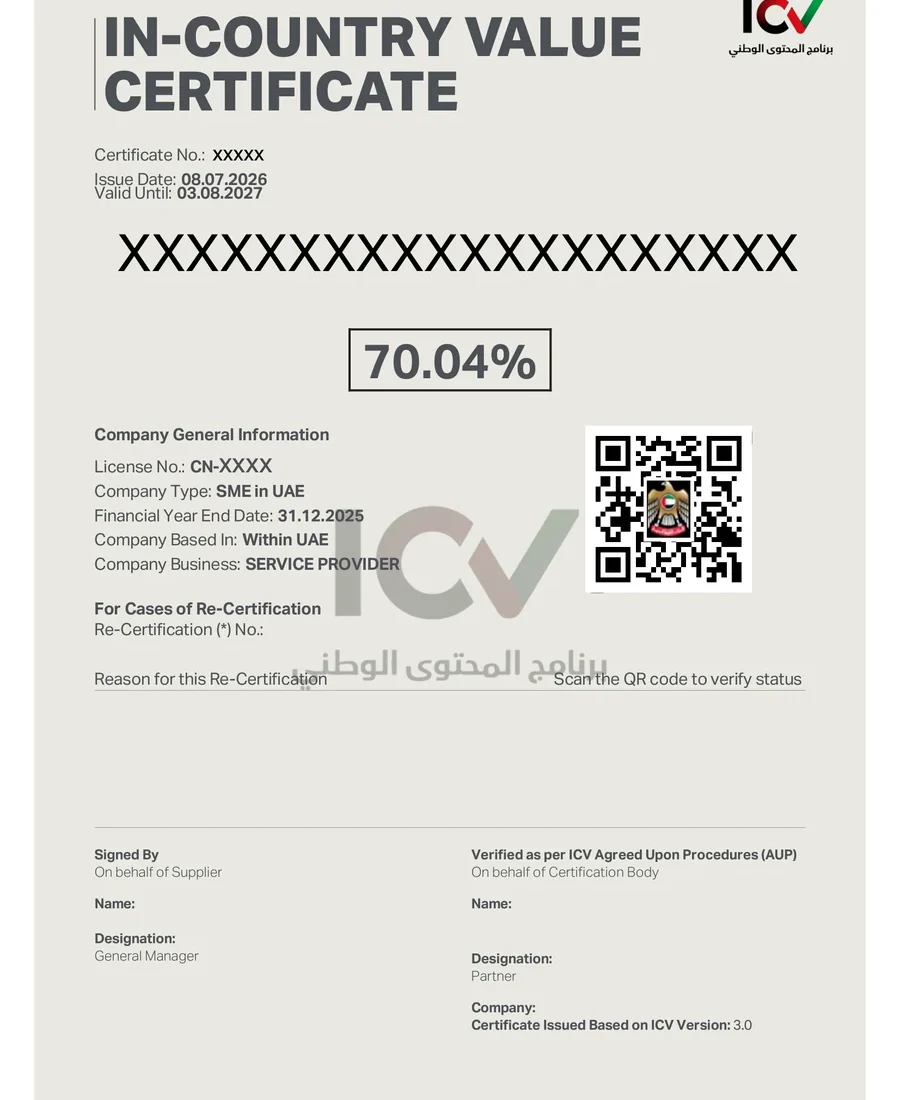
All figures come from your audited financial statements for the last financial year, which is why the certificate is tied to that audit and valid for 14 months from the audit report date.
1. The core ratio (up to 50%)
For a service provider the core component is:
Core = 50% × (ICV value of third party spend + Emirati staff cost + 60% of expat staff cost) ÷ (total third party spend + Emirati staff cost + expat staff cost)
- Third party spend is everything you bought in the year: purchases, subcontractors, rent, utilities, government charges and depreciation.
- Each line counts at the supplier’s ICV score. A supplier with a 40% certificate contributes 40% of what you paid it. A UAE mainland supplier without a certificate is counted at 10%. Foreign suppliers count as zero.
- Emirati staff cost (salaries, benefits, training on WPS payroll, plus qualifying donations) counts in full. Expat staff cost counts at 60%.
Manufacturers use the same idea with manufacturing cost instead of third party spend, and in-house UAE production counts in full.
2. Investment (up to 25%)
The base is 10% × the share of your fixed assets (net book value of property, plant and equipment, capital work in progress, investment property and capitalised software) held in the UAE. If all your assets are in the UAE, you get the full 10%.
The top-up rewards size: nothing below AED 5 million of UAE assets, rising to 5% at AED 50 million, 10% at AED 100 million and the full 15% at AED 150 million.
3. Emiratisation (up to 15%)
Based on what you spend on Emirati employees on WPS payroll, including training and qualifying donations of at least AED 120,000 to Sondoq Al Watan, Ma’an, NACD or listed government universities. Spend up to AED 200,000 earns 2%. Above that the score is 2% plus 13% × (Emirati cost in AED million ÷ 19.8), reaching the full 15% at about AED 19.8 million.
4. Expat contribution (up to 10%)
This part is driven by headcount, not salary:
| Expat employees in the UAE | Score |
|---|---|
| 1 | 1% |
| 2 to 4 | 0.5% per employee |
| 5 | 3% |
| 6 | 4% |
| 7 to 44 | 4% + headcount ÷ 22 |
| 45 to 50 | 6% |
| 51 to 200 | 6% + 3 × headcount ÷ 149, up to 9% |
| Over 200 | 10% |
5. Bonuses (up to 5%, plus 3% or 6%)
- ICV bonus, capped at 5%: 5% × your share of revenue from exports (UAE based companies only, re-exports excluded), plus 0.05% per Emirati employee, plus 5% × your growth in UAE assets compared with last year.
- Sustainability bonus for service providers, capped at 3%: 0.5% for each policy area you have implemented (strategy and governance, material circularity, water and wastewater, emissions) and 1% for an environmental ISO certification.
- Technology bonus for manufacturers, capped at 6%: based on a valid MoIAT technology assessment, plus 1% for environmental certification.
Worked example: a service company in Abu Dhabi
An Abu Dhabi mainland services company has these audited figures:
- Third party spend of AED 6,000,000: AED 2,000,000 with a supplier holding a 40% ICV certificate, AED 2,500,000 with UAE suppliers without certificates, and AED 1,500,000 with foreign suppliers
- 2 Emirati employees costing AED 620,000 including training
- 20 expat employees costing AED 4,000,000
- Fixed assets of AED 1,200,000, all in the UAE, up from AED 1,000,000 last year
- No exports and no sustainability policies yet
| Component | Working | Score |
|---|---|---|
| ICV value of spend | 2,000,000 × 40% + 2,500,000 × 10% + 1,500,000 × 0% = 1,050,000 | |
| Core | 50% × (1,050,000 + 620,000 + 60% × 4,000,000) ÷ (6,000,000 + 620,000 + 4,000,000) = 50% × 38.32% | 19.16% |
| Investment base | All assets in the UAE | 10.00% |
| Investment top-up | UAE assets below AED 5 million | 0.00% |
| Emiratisation | 2% + 13% × (0.62 ÷ 19.8) | 2.41% |
| Expat contribution | 4% + 20 ÷ 22 | 4.91% |
| ICV bonus | 2 Emiratis × 0.05% + 20% asset growth × 5% | 1.10% |
| Total ICV score | 37.58% |
What the example shows
The core ratio is worth the most, and the cheapest way to move it is usually your suppliers. If the uncertified UAE suppliers in the example obtained certificates scoring 35%, the core would rise from 19.16% to 22.10%, almost 3 points, without hiring anyone. By comparison, one more Emirati employee costing AED 240,000 a year adds about 0.9 points across core, Emiratisation and bonus. For more levers, see our guide to improving your ICV score.
Frequently asked questions
How is the ICV score calculated?
Under the MoIAT SEP 2025 template the score adds a core ratio (up to 50%), investment (up to 25%), Emiratisation (up to 15%), expat contribution (up to 10%), an ICV bonus (up to 5%) and a sustainability or technology bonus, all from your last audited financial statements.
What counts as third party spend?
Everything you procured in the financial year, including purchases, subcontractors, rent, utilities, government charges and depreciation. Each line counts at the supplier’s ICV score.
How are suppliers without an ICV certificate counted?
A UAE mainland supplier without a certificate is counted at 10%. Foreign suppliers count as zero. Asking your main UAE suppliers for their certificates is often the fastest way to raise the score.
What is a good ICV score?
It depends on the sector. Service companies commonly certify between 30% and 60%, and manufacturers with UAE facilities can exceed 70%. In a tender what matters is your score against the other bidders.
Who calculates the official score?
Only one of the 25 MoIAT authorised certifying bodies, through the national ICV platform. A calculator or consultant estimate is for planning; ZS prepares the template and supporting schedules and coordinates with the certifying body. See our ICV certificate service.
Based on the MoIAT ICV template, version SEP 2025, as applied in the ZS ICV Calculator. The certified score is set by an authorised certifying body from your audited figures. Reviewed by the ZS team, November 2026.
Need help with this? ZS is an FTA approved tax agency in Abu Dhabi. See our icv certification service or book a free one hour consultation.